← Back
The Man Who Learned to Follow Whales


Dr Alex Zerbini
For 25 years, Dr. Alexandre Zerbini has used the Argos system to track the ocean’s giants, and along the way, he had to reinvent the very tags that made it possible.
How a Childhood Encounter Inspired a Marine Biologist
In the sheltered bays of Península Valdés, on the Atlantic coast of Argentina, a southern right whale rolls at the surface and vents a plume of mist into the cold air. For a few seconds it is visible. Then it slips under and is gone, bound for feeding grounds that were, for generations, a mystery. For most of human history, that was where the story ended, a whale seen, then swallowed by the sea. For Alex Zerbini, it is where the work begins.
Following whales past that horizon, and bringing back a record of what they do out of sight, has carried him to nearly every ocean. But the impulse behind it traces to a different beach, an ocean away and decades earlier: a stretch of sand in Brazil, and a dolphin that should not have been there.
He was nine. He was walking the sand with his father and brother on a summer holiday when he came across the animal, tangled in a fisherman’s net. He went over and asked the man what he intended to do with it. Cut it up, the fisherman told him, and feed the meat to the dogs, they didn’t eat dolphins here. Something in the boy locked into place. “I need to understand more,” he remembers thinking. “I need to know more.” By his parents’ account he had been talking about becoming a marine biologist since he was three or four. He simply never stopped.

Tracking Whales Across the World’s Oceans
Today Zerbini is one of the world’s leading authorities on tracking large whales by satellite, with appointments spanning the University of Washington’s Cooperative Institute for Climate, Ocean, and Ecosystem Studies, NOAA’s Marine Mammal Laboratory, and the nonprofits Marine Ecology and Telemetry Research and instituto Aqualie. He has worked with the Argos system for about 25 years. And he has spent much of that time chasing a deceptively simple question: what do whales actually do when no one is watching, and how do we keep them safe once we know?
There is no single lab, no single field season. Zerbini works with teams scattered across the globe, and his own calendar reads like a migration route. In a single stretch of 2026 he ran a project in Argentina in May, tagged humpback and fin whales off New Jersey with collaborators from Rutgers University, and was two weeks out from a research cruise for killer whales in the Gulf of Alaska, with a major right-whale campaign in Argentina waiting in September and ongoing work in South Africa with the University of Pretoria. “I’m all over the world tagging and collaborating with people,” he said.

Why Satellite Tracking Is Essential for Whale Conservation
That restlessness has a purpose, and each project has its own quarry. In Alaska, three “ecotypes” of killer whale, one that hunts marine mammals, one that eats fish, one so elusive scientists simply call it “offshore”, behave so differently that telling them apart carries real stakes. The fish-eaters tangle with trawl fisheries and are sometimes caught and killed, so mapping their core habitat lets Zerbini warn the industry where the risk runs highest. And because the work is funded by the U.S. Navy, the tags also answer a question the Navy is obliged to address in its environmental impact assessments: of the killer whales its exercises might affect, what share belongs to each ecotype, and where. The Navy already knows roughly how many killer whales are out there; what it lacks is the breakdown. By researching them, Zerbini can show that the mammal-eaters favor one area for a stretch of time while the fish-eaters work another, the kind of detail the Navy can fold directly into its planning.
In Argentina, right whales double as a test bed for a new generation of miniaturized tags and as a window on how a warming ocean reshapes migration and habitat utilization. In South Africa, conflict in the Middle East has pushed shipping traffic down around the continent, and the increased risk of collisions have followed; Zerbini’s collaborators are working out whether a small nudge to a shipping lane might spare a whale’s life.
But the through-line of his career is not any one species. It is the instrument itself, and a discovery that forced him to become an inventor.

Reinventing Whale Tags for Better Science and Animal Welfare
Early on, Zerbini and his colleagues were losing tags at a startling rate, in some cases 40 percent failed, and not because of the electronics. The problem was the attachment. Most whale tags must be deployed from a distance and anchored beneath the skin, and no one had rigorously asked whether that was hurting the animals. An earlier mindset, he says bluntly, preferred not to look: “if something bad is happening, they’re going to stop us from doing this.” Zerbini went the other way. He collaborated with scientists who closely study humpback whales across decades in the Gulf of Maine. Because individuals in this population were well known, they could be resighted reliably, and instead of trusting the tag to find the whale, they found the whale to inspect the tag. What they initially saw wasn’t good, tags fracturing inside the body, the transmitter shearing off while the anchor stayed behind, swellings at the tag implantation site.
So they fixed them. Redesigned, the tags did not break, stayed on longer, and stopped causing the swellings; the tagged animals were measurably healthier. The payoff was scientific as well as ethical. “If the tags are affecting the natural behavior of the animals,” he explains, then the data no longer represent the population, and conservation advice built on skewed data can be wrong.
His rule for anyone entering the field is both a research standard and a creed: choose the right tag, test it, use a large enough sample, and “treat the animals carefully and with love.”

How Argos Improved Whale Tracking
The tags themselves are, in a sense, sacrificial. They work like a piercing, Zerbini says; the body slowly rejects them, they fall off, and the long-term ones are never recovered. Everything therefore depends on what the animal transmits before then, which is why the recent overhaul of the Argos system landed on his work like a jolt of new power. The arrival of the Kinéis nanosatellite constellation has been, in his words, “a massive improvement in data quantity and data quality.” His one wish is that the new pipeline were as automated as the old one, a growing pain of a system still settling in.

Not all of the tracking happens from orbit, though. In the field, Zerbini leans on a goniometer, a highly sensitive handheld direction finder that listens for a tag’s own Argos signal and points toward it, giving a bearing and a rough distance from as far as several kilometers off in good conditions.
It is how his teams relocate a tagged whale on the water weeks to months after deployment, drawing close enough to photograph the animal and judge its body condition, the follow-up that tells them whether a tag is doing harm. And for the shorter-term tags that are meant to be retrieved, the goniometer, often paired with radio telemetry, is how they home in on a small transmitter bobbing somewhere on the sea and recover it, along with the data stored inside, before the currents carry it out of reach.
As he tells newcomers, the more ways you have to find an instrument, the Argos satellites, radio, the goniometer, the better your odds of getting it back.
Asked what else he wanted the people behind Argos to hear, Zerbini offered thanks and a challenge. He and his fellow users deeply appreciate the leap the new satellites represent, he said, and he urged Argos, CLS, and Woods Hole Group to keep pushing, the technology helps the animals, and it reaches far beyond them into countless human uses.
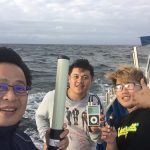
Then he turned to his interviewers with an invitation of his own: come out in the field with us. His projects always have room, he told them, and next year’s field work would be a great opportunity for a visit, a few days on the water is enough to see how a whale is actually tagged. It is the same reason he has long brought tag engineers along: an afternoon beside a whale tends to change how a person designs and deploy the thing that goes on it.
Which, in the end, is the same instinct that stopped a nine-year-old on a Brazilian beach: to go closer, and to know more.
This spotlight is drawn from Dr. Zerbini’s July 2026 interview with the Argos team. Spoken quotes have been lightly edited for clarity without altering their meaning. Biographical and technical background (institutional roles; details of the Kinéis constellation) verified against public sources including CICOES/University of Washington, NOAA, CLS/Argos, and Wildlife Computers.
If you’re interested in sharing your story, contact our experts.